The Mediterranean appeal of open space
Mediterranean architecture has celebrated the relationship between indoors and outdoors for centuries. Andalusian patios, Italian terraces open to the sea, Greek houses oriented towards the light: all share the same philosophical principle. Space does not end where the wall begins; it flows, expands, invites.
In this context, the open-plan kitchen is not a fashion imported from northern Europe nor a passing trend from interior design magazines. It is the logical consequence of a way of living in which life unfolds around the table, hosting guests is a daily ritual, and natural light is the most valuable building material.
When a family considers building or refurbishing a villa in Marbella, Benahavís or Sotogrande, the question of whether to open up the kitchen inevitably arises in the earliest design meetings. And the answer, as with almost everything in architecture, depends on multiple factors that go far beyond aesthetics.
What we really mean by an open kitchen
It is worth clarifying that an “open-plan kitchen” is not a monolithic concept. There are different degrees of openness, each implying distinct technical solutions and user experiences:
Fully integrated kitchen: The cooking, preparation and storage areas form part of the same space as the living-dining room, with no physical separation whatsoever. It is the most radical and visually striking option, but also the one that places the greatest demands on ventilation and tidiness.
Semi-open kitchen with island: The island or breakfast bar acts as a subtle dividing element. It marks a psychological boundary without enclosing the space. This is probably the most widespread solution in luxury villas on the Costa del Sol because it offers the best of both worlds: visual connection with the living area and a degree of functional zoning.
Kitchen with glazing or sliding doors: This allows the space to be closed when desired — for example, during a formal dinner or when cooking dishes with intense aromas — and fully opened the rest of the time. It is an especially intelligent solution for clients who value flexibility.
Outdoor or summer kitchen: In the Mediterranean climate, there is a fourth variant that many clients do not initially consider: integrating a cooking area on the terrace or under a covered porch. When architecturally well resolved, this option can perfectly complement the indoor kitchen and decisively solve issues of odours and heat.
The real challenge: ventilation and extraction
If there is one technical aspect that determines the success or failure of an open-plan kitchen, it is ventilation. And it is precisely here that many projects which looked perfect on paper end up generating dissatisfaction in daily use.
The problem is simple to state: when cooking — especially grilling, frying, or preparing Mediterranean stews with spices and olive oil at high temperatures — vapours, airborne grease and odours are produced which, in a closed kitchen, remain contained within that space. In an open-plan kitchen, those same vapours have immediate access to the living room, dining area and, if doors are open, the garden and terraces.
The solution necessarily involves an extraction system that is oversized compared to what would be typical in a conventional kitchen. But here a new problem arises: high-powered extractors generate noise. And in an open-plan kitchen, noise propagates without barriers into the rest of the living space.
The response to this dilemma has several facets from an architectural design perspective:
Early planning: The position of the hood and the routing of extraction ducts must be planned from the outset of the project, never as an afterthought. A poorly dimensioned duct or one with too many bends drastically reduces the efficiency of any extraction system.
Perimeter extraction systems: Downdraft or perimeter systems — integrated into the worktop rather than suspended above it — have advanced significantly in recent years and offer a quieter, aesthetically cleaner alternative for kitchens where a conventional hood would disrupt visual continuity.
Natural cross-ventilation: The building’s own natural ventilation can be a powerful ally if designed correctly. A well-oriented Mediterranean villa with strategically placed openings can harness the breeze to ventilate naturally for much of the year, reducing reliance on mechanical systems.
Design, order and lifestyle: the part no one talks about
Beyond technical aspects, an open-plan kitchen imposes a level of order and maintenance that not everyone is willing to assume. In a closed kitchen, occasional clutter — breakfast dishes left unwashed, scattered spices, remnants of meal preparation — remains out of sight from the living room. In an open-plan kitchen, that same scene becomes part of the landscape.
This is not an argument against open-plan kitchens; it is simply a reality worth anticipating. Architects working on high-quality residential projects know that design cannot ignore clients’ real habits. A family with young children, someone who cooks elaborate meals daily, or a person who simply prefers their resting space to be visually disconnected from the work area may find a semi-open kitchen or a solution with operable doors more appropriate.
For this reason, during the initial project phases, it is essential for architect and client to maintain an honest conversation about how the home will actually be used. Luxury Mediterranean villas are not magazine houses; they are living homes, and design must serve those who inhabit them.
Light, proportion and materiality: when an open kitchen truly works
When all factors align — a family that enjoys the kitchen as a social space, an orientation that allows natural ventilation, sufficiently high ceilings for efficient extraction, and an orderly lifestyle — an open-plan kitchen in a Mediterranean villa can be genuinely transformative.
The morning light entering through large living-room windows and bathing the kitchen island, the aroma of coffee blending with the scent of the garden drifting through doors open to the porch, children doing homework on the sofa while dinner is prepared: these everyday scenes that many clients describe as their ideal home are only possible when space flows uninterrupted.
In terms of materiality, the kitchens that function best in this type of dwelling are those that adopt a palette consistent with the rest of the living area. Natural stone worktops — white Macael marble, grey quartzite, slate — that converse with the flooring. Handleless kitchen fronts lacquered in colours that merge with wall tones. Integrated lighting that does not distinguish between cooking and living zones.
An example that summarises it all: our Aloha Sur Project
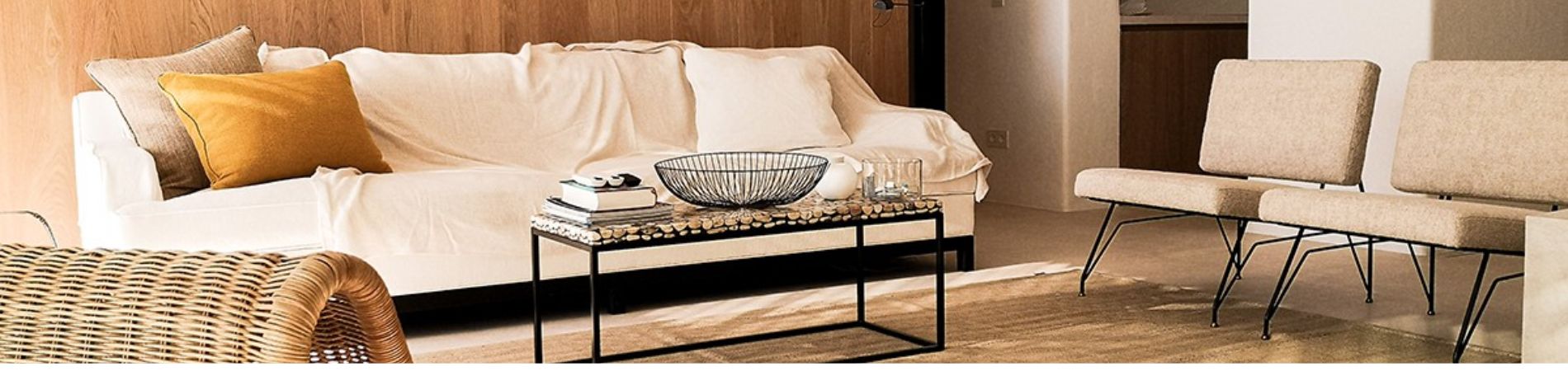
Theory comes to life when seen applied in a real project. Our Aloha Sur Project is one of the examples that best illustrates this philosophy of spatial integration in contemporary Mediterranean architecture. The ground floor of this home is organised around an open-plan design that harmoniously fuses the living room, kitchen and dining area, achieving spatial continuity without sacrificing functionality or elegance.
What makes Aloha Sur particularly interesting from the perspective of the open-plan kitchen is precisely the naturalness with which this integration occurs. It is not simply about removing a wall; it is about conceiving from the outset a space in which each area has its identity, yet none acts as a sealed compartment. Light, proportion and materiality work together to create that sense of controlled spaciousness that defines the finest Mediterranean residential architecture.
Beyond the wall: the kitchen as the heart of Mediterranean life
Open-plan kitchens represent far more than an aesthetic trend: they are a statement about how we wish to live. In the context of a Mediterranean villa — where the way of inhabiting space is intrinsically open, social and luminous — they make perfect sense when designed with technical rigour and adapted to the real lifestyle of their inhabitants.
The key, as always in architecture, lies not in following formulas but in listening. Listening to the place, the climate, the orientation, the light. And above all, listening to the people who will turn that villa into their home.